The organisation functions in a dynamic and complex environment and stakeholders have an impact in varying ways in to varying degrees depending on the situation.
It’s important to understand what or who a stakeholder is.
In simple terms anyone or any organisation that has any impact on or influence over the actions, behaviour and results of an organisation.
You need to know what their objectives are – they might not align with your objectives. The relationships can get complex and must be managed carefully.
Customers are obvious stakeholders – they make decisions to buy the organisation’s products/services.
These may be simple one off transactions or they could be based on a long term relationship – brand loyalty, promotions that encourage repeat purchases (loyalty schemes etc) and referrals to others in their network.
Importantly the customer network can go beyond family and friends and may include social media communities.
Great when everyone is happy but potentially very damaging if a customer has a bad experience and shares it. This problem (and benefit) can be greatly amplified by various web based feedback platforms such as Trustpilot etc.
In recent years the internet and social media has created a great many new “touch points” for the organisation. Influencers are often used to promote an organisation and the products/services.
This can be very positive but can also be very negative if the influencer becomes discredited for any reason.
Other important stakeholders include:
-
Banks and investors
-
Suppliers
-
Partners
-
Employees (and even their families)
-
Local communities
-
Government, tax authorities and regulators
-
Media – including social media and influencers
The list can get quite long.
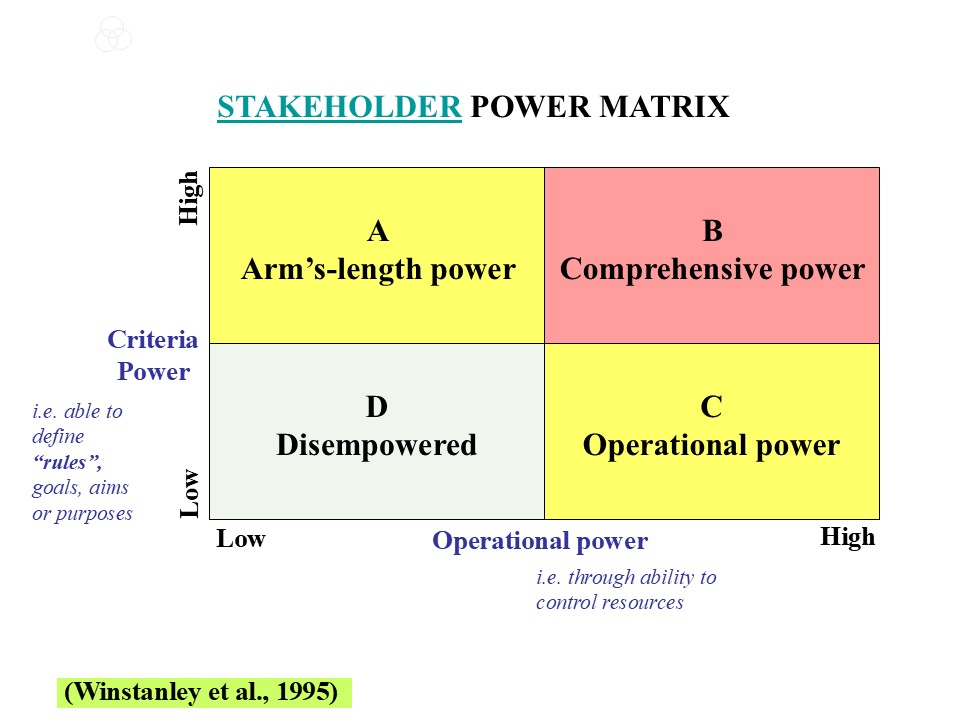
It’s important to manage the relationships and the matrix below helps to show who has power over the strategy of the organisation and who has power over the operations.
The relationships are dynamic and stakeholder positions in the matrix can move depending on circumstances.
A simple example:
As part of the scaling up you have taken a bank loan and have an overdraft facility with the same bank.
You are left alone if you maintain loan payments in accordance with the loan agreement and stay well within your overdraft.
The bank choose to exercise very little strategic or operational power – not quite disempowered but low level.
Then
You are at the limit of your overdraft and you miss a loan repayment. The bank now have comprehensive power – they can tell you what you can and can’t do and even initiate action to close the company.
You can’t ignore this – perhaps you could have (should have) anticipated the developing problem and talked to the bank before it became a big problem.
This may seem extreme but all staekholder positions can change depending on circumstances – sometimes outside your control but you have to manage the consequences.
The matrix below helps to frame where your stakeholders are at any moment in time.
Good stakeholder management helps you anticipate where they might move to and how you might influence such moves.
You may not be able to stop some of the moves – some may be beneficial or negative.
But knowing the possibilities is important and minimises the impact of “bad luck”.